T-RIZE Group has launched a $500 million digital bond program on Canton Network, for Horizon Group. The program, called Kairos Digital Loan Notes (token KAI18-1) begins with an intial $50 million tranche available to qualified investors in the U.S. and Europe. Particula Ratings, a risk rating agency specialized in digital assets, announced on April 2, 2026 the very first issued risk rating to a tokenized asset on the Canton Network. The agency assigned a pre-issuance rating of “B+” to the KAI18-1 token (Kairos Digital Loan Notes) tokenized instrument.
In this article, we break down the entire construction of this instrument. Beginners, we’ve got you covered: don’t lose the thread of the article, stick with it until the end – in 10 minutes of reading, we walk you through a complete understanding of what is being built here on Canton Network by T-RIZE & Horizon Group.
Litigation finance receivables: core economics of the structure
The economic core of the instrument is “litigation finance”: the act of funding legal proceedings. Horizon Group lends money to law firms so they can process a large volume of consumer cases – here, “motor finance mis-selling” cases in the United Kingdom. The instrument is designed to benefit from the financial compensation framework linked to this automotive finance scandal.
In practice, many consumers have been harmed in automotive financing contracts: law firms must process these cases, which costs money even before compensation is received. Horizon Group provides this interim financing. By purchasing KAI18-1, investors are exposed to this economic model.
KAI18-1: Understanding the tokenized debt instrument
The instrument is not equity, is not a utility token, and is not a direct share in lawsuits. It is a “digital loan note”, meaning a digital debt note issued by Kairos Litigation Limited. This means that by purchasing the KAI18-1 token, the investor lends to the issuer (Kairos) and holds a debt claim against it. This debt must be repaid to the investor by Kairos, through the economic flows generated by a portfolio of litigation finance exposures.
KAI18-1 is therefore a tokenized debt instrument, indirectly backed by litigation finance receivables.
Understanding the structure: key parties & roles
The structure relies on a chain of roles. If you manage to understand each role, then you will have a full understanding of the instrument. Shall we begin?
Horizon Legal Limited:This is the “program manager”, the business engine of the deal. Horizon sources opportunities, organizes loans to law firms, and monitors performance.
Kairos Litigation Limited: This is the SPV (Special Purpose Vehicle), a company created specifically for this deal. An SPV is a company created for a specific purpose — here: to carry only this deal. Kairos Litigation Limited cannot conduct other activities in parallel. The benefit of this structure is that if everything were done directly within Horizon, investors would be exposed to the company’s other risks.
With an SPV, the goal is to isolate the assets and cash flows of the instrument from the rest of the group. This is referred to as a “bankruptcy-remote” structure. The objective is to ensure that if any party involved in the deal faces financial issues, the assets of the deal remain as protected and segregated as possible. Kairos Litigation Limited therefore issues the debt and holds the deal’s assets, all while being structured as a separate legal shell.
Borrowing law firms:Referred to as “Approved Solicitors”, they receive the funds to advance the cases. They are the ones using the capital operationally. The cases are sourced for them by “Claim Management Companies (CMCs)”, which feed the economic engine of the deal.
The on-chain technology layer, T-RIZE Group & Canton Network:T-RIZE handles the digital layer: creation of the KAI18-1 token, onboarding, position recording, transfer rules, governance, and lifecycle. The token is deployed on a permissioned institutional network, the Canton Network, launched in May 2023 by a consortium including Goldman Sachs, BNP Paribas, Deutsche Börse, Cboe, Deloitte, Capgemini, Microsoft, and among others, Digital Asset, which counts strategic investors such as BNY Mellon, Nasdaq, S&P Global, HSBC, and iCapital. T-RIZE Group deploys on Canton Network two applications, including one dedicated to real-world asset tokenization.
T-RIZE has gained strong traction within Canton Network in recent months. In December 2025, Madani Boukalba was announced as a board member of the Canton Foundation, elevating T-RIZE to a premier members position within the network.
The insurance layer: Coordinated by Ramon International Insurance Brokers, it is composed of surety providers (Talisman Surety & Fidelity Company). These provide the “performance bond”, covering the repayment of the principal of loans made to law firms. The surety providers do not bear the entire risk alone – a second insurance layer exists: the risk is “reinsured” by AmFirst Specialty Insurance Company. The structure is also complemented by ATE (After-the-Event) insurance, which covers risks related to litigation outcomes, particularly in the event of failed claims and adverse costs.
The distribution layer: The US distribution layer is handled by Texture Capital, acting as a broker-dealer registered with the SEC and a member of FINRA. Within a “private placement under Regulation D”, Texture Capital supports the issuer in structuring and executing the offering. For Europe, distribution is handled by Black Manta Capital Partners, a financial institution regulated by BaFin and compliant with MiFID II.
The security interests layer: This layer refers to the legal protections put in place to safeguard investors and enable recovery of funds in the event of default. It grants security interests over certain assets and cash flows of the instrument, as well as a defined enforcement framework. This layer is managed by OPPA Limited, acting as a security agent. It represents investors, administers collateral, controls cash flows through a “blocked account agreement” with HSBC UK Bank PLC, and ensures enforcement upon default.
Transaction flows and protection layers: structural overview
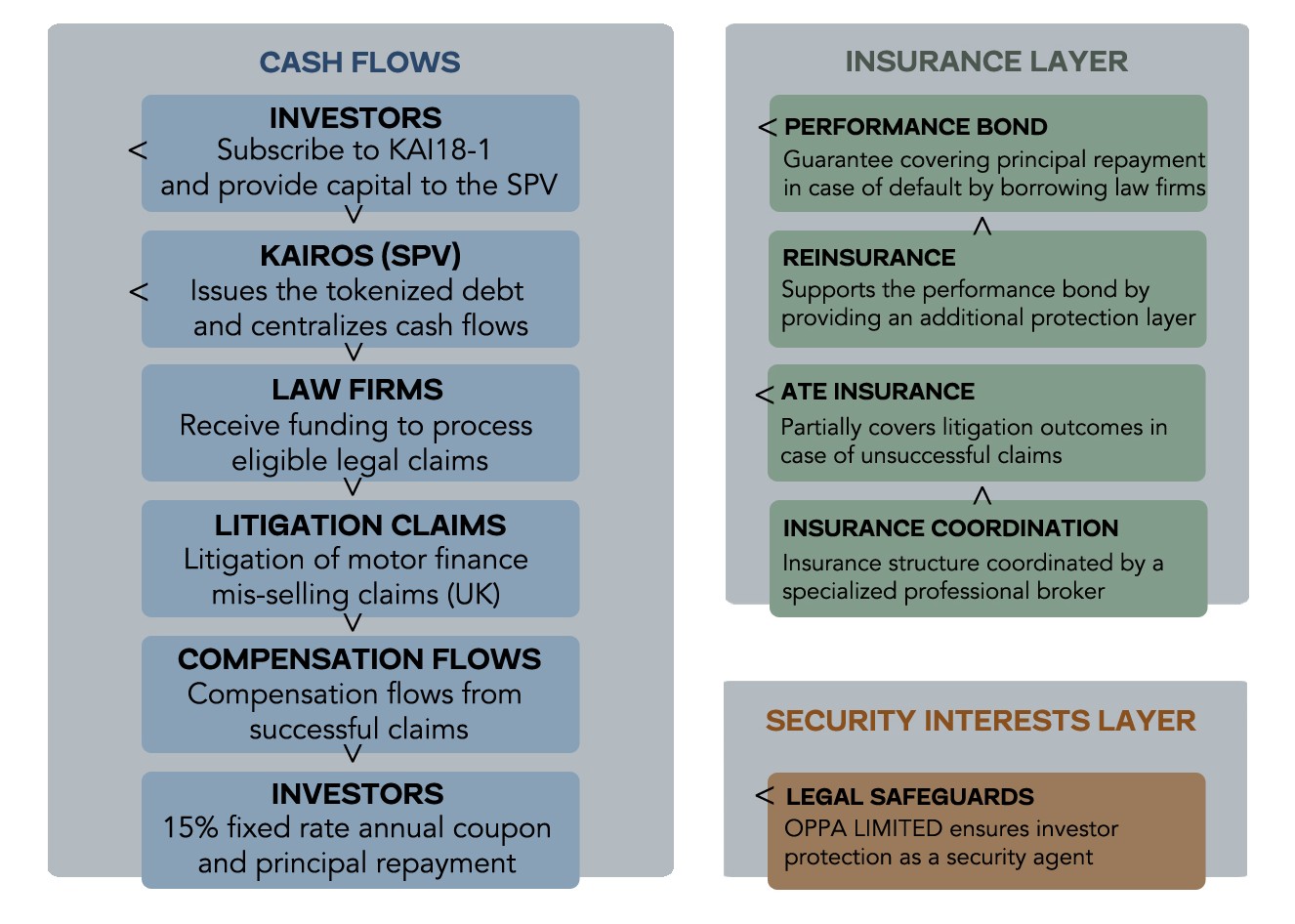
After investors subscribe to KAI18-1 tokens, the capital raised flows through the SPV (Kairos) and is used to issue loans to law firms. These firms then finance the progression of legal claims. Compensation from successful cases ultimately feeds the SPV’s cash flows, enabling it to repay principal to investors and pay interest on the notes.
Within the insurance layer, coordinated entirely by a specialized broker, the performance bond covers default by borrowing law firms. The performance bond does not cover all risks – a reinsurance layer is implemented to cover the risk carried by the performance bond. In addition, ATE (After-the-Event) insurance covers part of the risk of unsuccessful claims, particularly adverse costs.
Within the security layer, OPPA Limited acts as security agent to represent investors and ensure proper implementation of legal safeguards. These safeguards notably cover the assets and cash flows of the SPV (Kairos), providing a protection framework in case of default.
T-RIZE on-chain layer architecture: enabling institutional-grade distribution on the Canton Network
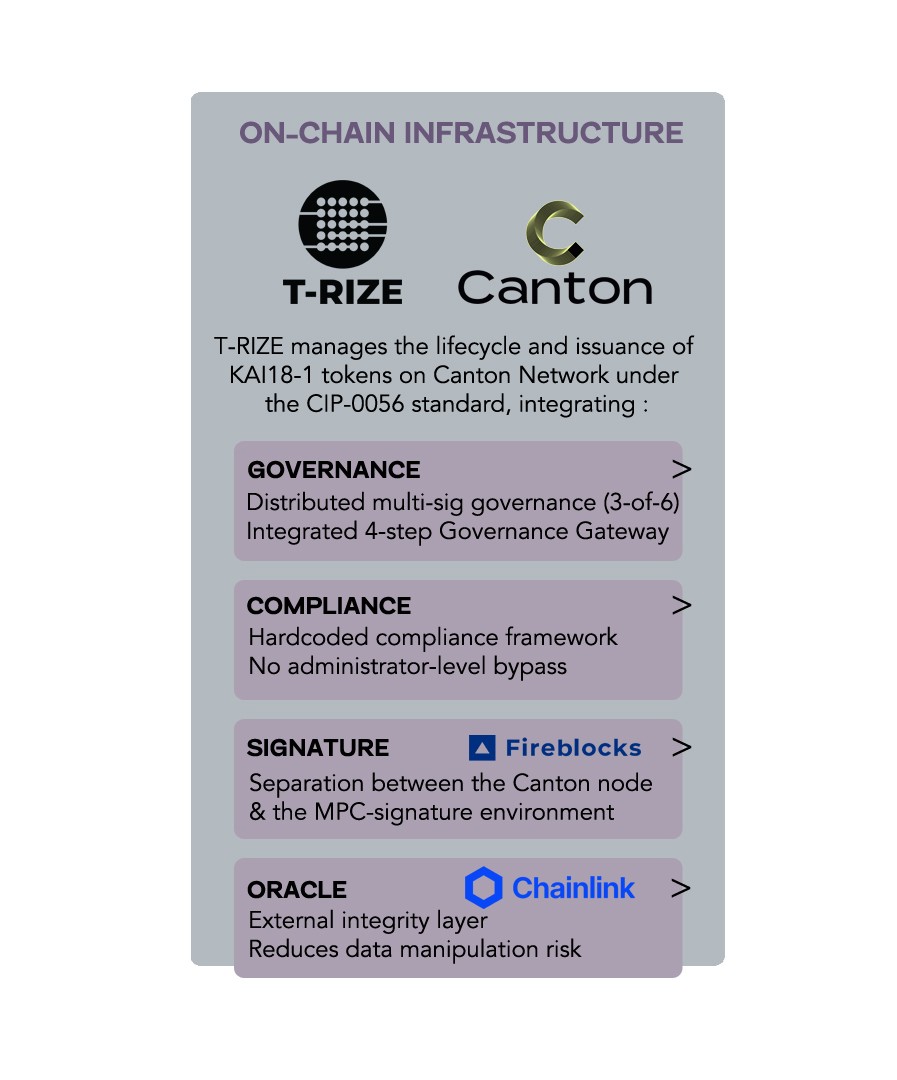
Particula, in its rating report, details several specific on-chain structures implemented by T-RIZE. This structuring and these design features directly contribute to a higher instrument rating, highlighting T-RIZE’s excellence in structuring tokenized assets for institutional actors. Without going too deep into the technical details, here is an overview.
Exceeding the base technical standard CIP-0056 : Particula highlighted that T-RIZE went beyond the base requirements of the CIP-0056 standard (an “ERC-20 equivalent” with its own specificities on Canton Network) for the KAI18-1 token, notably by implementing governance and authorization controls.
Advanced and differentiated multi-signature governance : Particula emphasized the distributed governance model. An advanced “3-of-6” multi-signature structure, split equally between Kairos (issuer), T-RIZE (on-chain infrastructure), and Texture Capital (distribution), ensures no single actor can act alone. A differentiation layer was also introduced, separating critical functions (3-of-6) from emergency cases (pause/unpause), built as 2-of-3 and assigned solely to T-RIZE.
Elimination of arbitrary governance risk: By implementing an on-chain “Governance Gateway” in four steps (proposal, multi-signature, time-lock, then execution), T-RIZE eliminates arbitrary governance risk.
Hardcoded compliance, embedded at the core of the product: Compliance aspects are non-bypassable – they are embedded in the smart contract structure rather than external to the product, ensuring no administrator-level override or bypass is possible.
Separation between the Canton node and the signature environment: Particula highlights the benefits of separating the node from the Fireblocks signature environment, which relies on MPC (multi-party computation). Unlike a traditional system relying on a single private key (held in one location), MPC fragments the key across multiple entities that must collaborate to validate a transaction without ever reconstructing it fully. Combined with the separation from the node, compromise risks are significantly reduced.
Integration of a Chainlink oracle as an external integrity layer: By adding an independent verification source via an oracle (Chainlink via Merkle root), T-RIZE introduced an external integrity layer that reduces data manipulation risk.
All of these elements demonstrate T-RIZE’s ability to transform a simple tokenized asset into an institutional-grade financial instrument by embedding governance, compliance, security, and control mechanisms directly into the on-chain infrastructure – covering the entire lifecycle of the instrument, aspects typically managed off-chain.
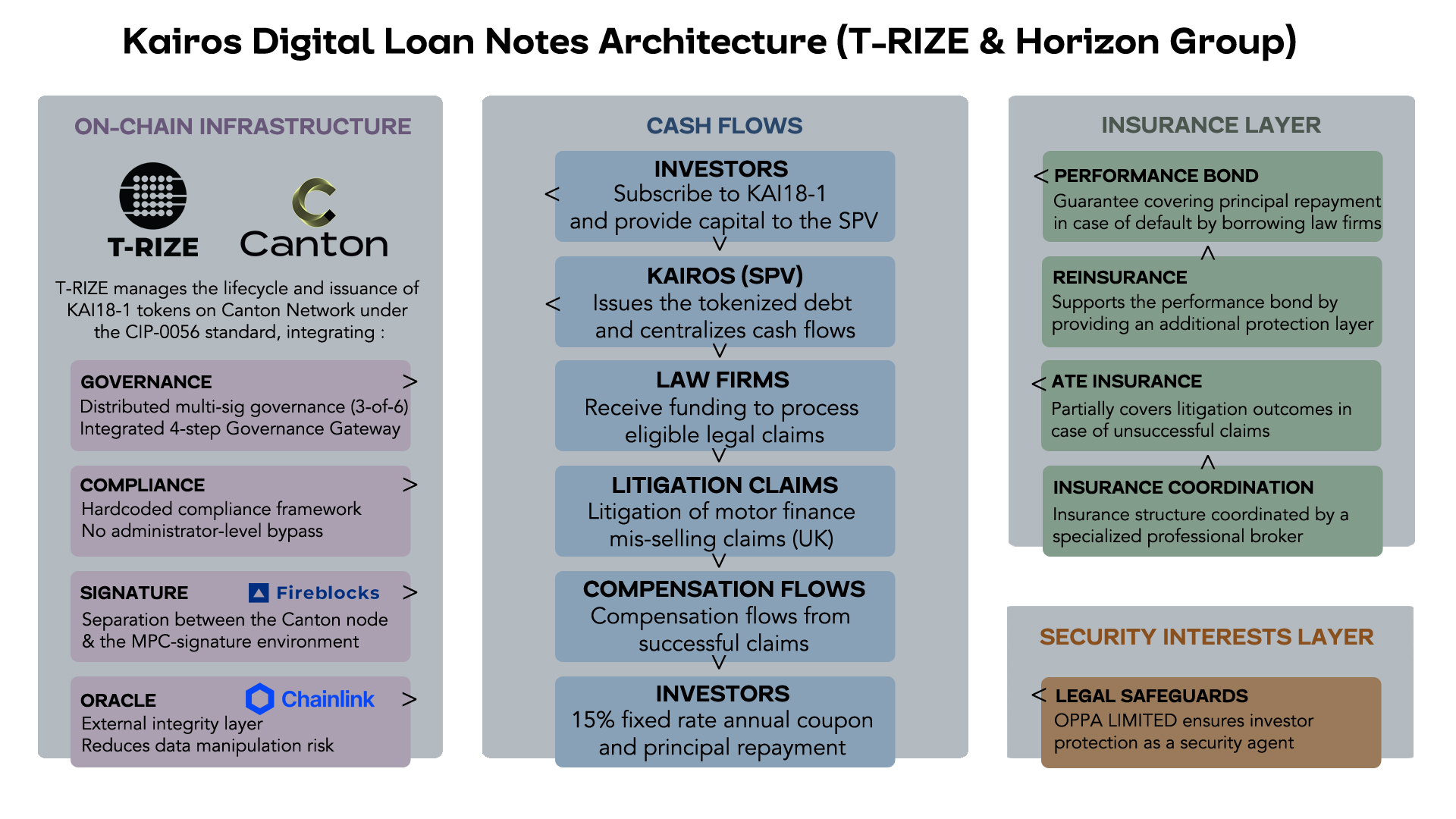
The investor therefore purchases, on-chain via Canton Network, a tokenized debt claim on an SPV, repaid through compensation flows from litigation claims, with legal, insurance, and on-chain protection layers. T-RIZE provides the tokenization engine, access control, governance, and digital administration that allow the KAI18-1 security token to properly exist on Canton Network with a B+ rating assigned by Particula.
The tokenized instrument’s core bet relies on the assumption that mass litigation related to “motor finance mis-selling” in the UK will generate sufficiently strong and timely cash flows to service a structured debt within a framework that is highly robust from both a legal and technological standpoint.
 TOKERIZE